Search engine optimization (SEO) for blogs has undergone significant changes. Years ago, ranking high on Google mainly meant adding the right keywords. Today, it’s much more about understanding your readers, building trust, and writing genuinely helpful content.
Three things now play a major role in blog SEO:
-
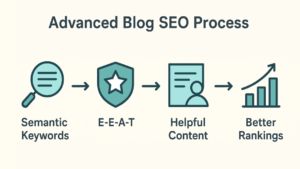
Semantic Keywords – writing naturally using related words and meanings, not just repeating one keyword.
-
E-E-A-T – showing your Experience, Expertise, Authoritativeness, and Trustworthiness.
-
Google’s Helpful Content Update – creating content that truly helps people, not just search engines.
Let’s connect the dots between these three and learn how to use them together to make your blog stronger, more discoverable, and more valuable.
1. What Are Semantic Keywords (and Why They Matter)
The old way vs. the new way
In the past, people used to pick a main keyword (like “blog SEO”) and repeat it everywhere in the title, headings, and body. That worked once, but not anymore.
Today, Google’s search algorithm understands meaning and context, not just exact words.
So instead of counting how many times you used a keyword, it looks for how deeply your content covers a topic.
So what are semantic keywords?
Semantic keywords are words and phrases related to your main topic.
If your main keyword is “blog SEO”, your semantic keywords could be:
-
“on-page optimization for blogs”
-
“how to increase blog traffic”
-
“content structure and SEO”
-
“search intent”
-
“keyword clustering”
These related terms help Google see that your article truly understands the topic.
How to use them correctly
-
Start with your main topic. Use keyword tools (like Google’s “People Also Ask” or AnswerThePublic) to find related terms.
-
Think about your reader’s questions. What would someone actually want to know about this topic?
-
Write naturally. Don’t force keywords in — they should fit the flow of your sentences.
-
Cover the topic in depth. Answer related questions, give examples, and add value.
-
Link to other posts. Use internal links to connect related articles. This builds topical strength.
Quick Example:
If you’re writing “How to Do Blog SEO in 2025”, you might include sections like:
-
How Google’s algorithms work today
-
Tools for keyword research
-
Writing content that ranks
-
Measuring SEO results
By doing this, you’re using semantic keywords naturally and Google loves that.
E-E-A-T: The Foundation of Trust
What does E-E-A-T mean?
E-E-A-T stands for:
-
Experience – Do you have first-hand knowledge?
-
Expertise – Are you skilled or knowledgeable about the topic?
-
Authoritativeness – Do others see you as a reliable source?
-
Trustworthiness – Can readers believe what you say?
Google uses these principles to judge whether content is credible and worth ranking higher.
Why it matters for your blog
Google’s mission is to show people trustworthy information. If your blog demonstrates experience, expertise, and trust, Google will likely rank it better.
Think of it like real life:
Would you trust financial advice from an anonymous post, or from a certified expert who’s been in the industry for years?
How to show E-E-A-T on your blog
-
Show your experience.
-
Share personal stories or case studies.
-
Example: “After optimizing 30 blog posts, I increased traffic by 80%.”
-
-
Display expertise.
-
Write in a way that shows you understand your topic deeply.
-
Include your credentials or years of experience in your author bio.
-
-
Be authoritative.
-
Get mentioned or linked to by other respected websites.
-
Publish consistent, well-researched posts.
-
-
Build trust.
-
Use HTTPS (secure site).
-
Avoid clickbait titles.
-
Cite reliable sources.
-
Be transparent about who you are and how to contact you.
-
Pro tip: Add an “About” and “Author Bio” section to every post it’s a simple but powerful E-E-A-T signal.
3. Google’s Helpful Content Update (People-First SEO)
What is it?
Google’s Helpful Content Update focuses on rewarding content written for people, not for search engines.
This means that if your blog mainly exists to trick Google’s algorithm with keyword stuffing or AI-generated fluff it might not rank well.
What Google wants to see
According to Google, content should:
-
Be written for real readers.
-
Clearly show first-hand experience.
-
Fully answer what people are searching for.
-
Be regularly updated and factually correct.
-
Offer a good user experience (fast load time, mobile-friendly, easy to read).
What this means for you
To align with this update, make sure your blog content:
-
Helps the reader solve a real problem.
-
Goes deep enough to satisfy search intent — don’t write just 300 words on complex topics.
-
Avoids filler or repetitive info.
-
Uses clear structure — headings, bullet points, short paragraphs.
-
Feels trustworthy — accurate facts, proper sourcing, and no misleading claims.
Ask yourself before publishing:
“Would someone bookmark or share this post because it truly helped them?”
If yes, you’re writing helpful content.
4. Connecting the Dots: A Unified SEO Strategy
Let’s put it all together.
Here’s how Semantic Keywords, E-E-A-T, and the Helpful Content Update work hand-in-hand:
| Concept | What It Does | How It Helps SEO |
|---|---|---|
| Semantic Keywords | Expands your topic coverage | Google sees your content as more complete and relevant |
| E-E-A-T | Builds your credibility | Google and readers trust your information |
| Helpful Content Update | Keeps your focus on user needs | Google rewards people-first content |
Step-by-step plan
-
Do smart keyword research.
Find your main keyword, then list 10–15 related semantic terms. -
Plan your content.
Create an outline that naturally includes these terms. -
Write with E-E-A-T in mind.
Add your experiences, data, or quotes. Write like an expert sharing real advice. -
Make it helpful.
Give readers something they can use immediately a checklist, a tool suggestion, or a step-by-step method. -
Optimize and link.
Internally link to related posts, cite sources, and format for readability. -
Review and update.
Every few months, check if your information is still current. Update stats, screenshots, and add new insights.
Example:
Imagine your main topic is “Advanced Blog SEO.”
You could create smaller linked posts like:
-
“How to Research Semantic Keywords”
-
“Simple Ways to Improve Blog E-E-A-T”
-
“What Google’s Helpful Content Update Really Means”
This cluster strategy helps Google understand that your site is a trusted authority on blog SEO.
5. Common Mistakes to Avoid
Even experienced bloggers slip up. Here are some easy-to-avoid errors:
| Mistake | Why It Hurts | Fix |
|---|---|---|
| Keyword stuffing | Feels unnatural, Google penalizes it | Write naturally, not repetitively |
| Copying others’ content | No originality, no trust | Add your voice, examples, and insights |
| Ignoring author bio | Readers don’t know who you are | Always include author info |
| Writing for bots | Low engagement | Focus on reader needs |
| Never updating old posts | Outdated info loses trust | Refresh content regularly |
| Too many ads or popups | Hurts UX | Keep layout clean and reader-friendly |
6. Quick SEO Checklist
Before publishing, run through this:
- Is your topic clear and helpful?
- Have you included related (semantic) keywords naturally?
- Does your content show real experience or data?
- Do you have an author bio and references?
- Is your blog mobile-friendly and fast?
- Have you linked to related articles on your site?
- Does your post fully answer the reader’s question?
If you can answer “yes” to all, your post is well-optimized for 2025-style SEO.
SEO today isn’t about tricking algorithms it’s about earning trust and providing value.
When you:
-
Use semantic keywords to cover a topic naturally,
-
Show E-E-A-T through real experience and authority, and
-
Follow Google’s Helpful Content guidelines to serve readers first,
You create blog posts that not only rank high but also build loyal audiences.